Updated on 7 November 2026.
An AI voice assistant answers the phone for you, understands what the caller wants and can give information, book an appointment or pass the call to a person. It works well on repetitive requests (opening hours, availability, bookings) and badly on complex or emotional ones. Callers must know that an AI is on the other end, and recorded calls need a privacy notice.
I’m Toure Tia Kevin, a web developer in Bassano del Grappa, Italy. I don’t sell a voice assistant service: this guide helps you decide whether you need one, based on the text of the rules linked at the bottom, read on 7 November 2026. Where I give my own opinion, I say so. On the rules, this is not legal advice.
How it works
An AI voice assistant combines three parts, often offered together by one platform:
- Speech recognition: turns what the caller says into text.
- Language model: understands the request and decides the reply, following the instructions you give it (hours, services, booking rules).
- Speech synthesis: reads the reply aloud with an artificial voice.
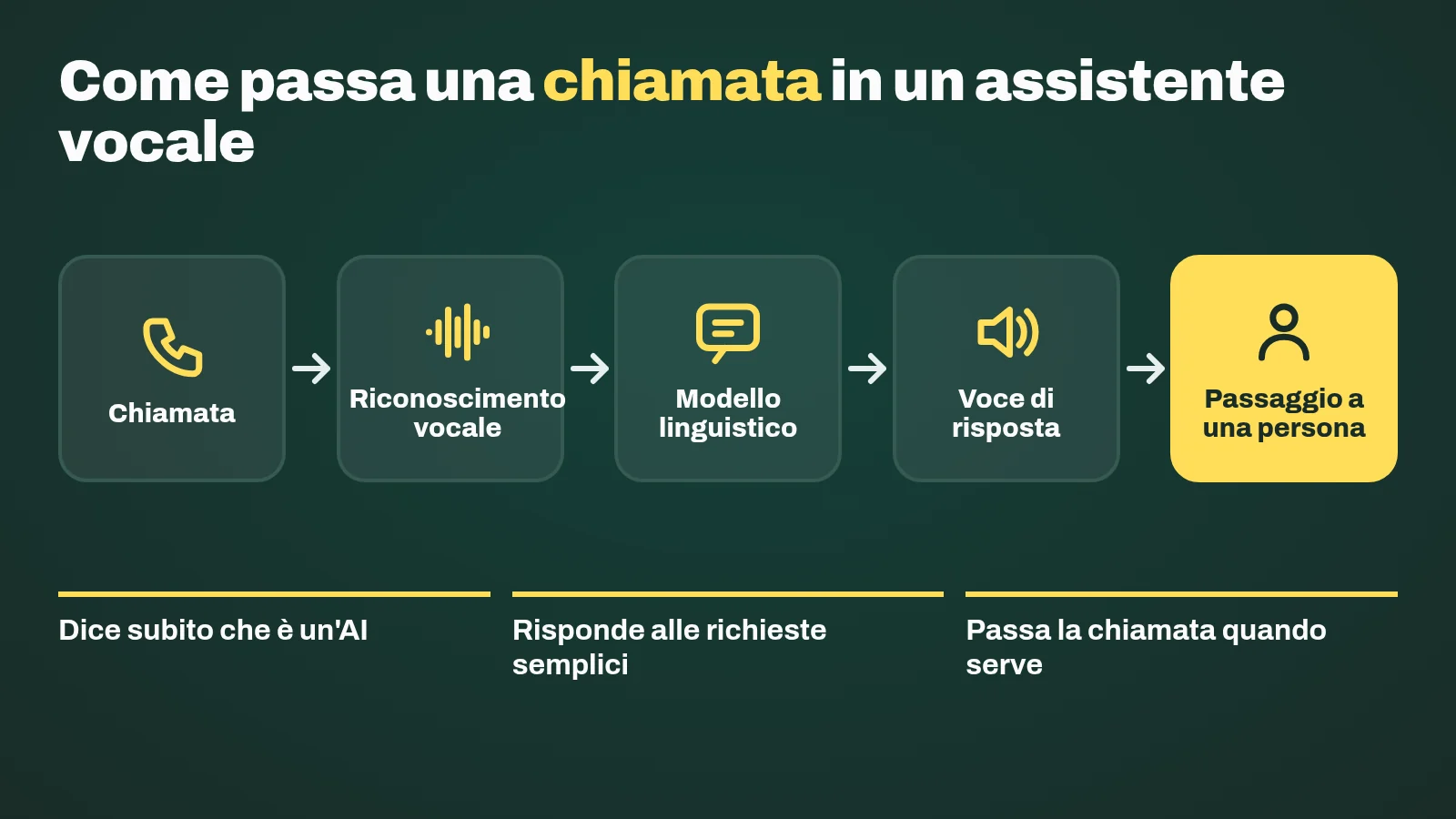
Then there is the phone connection: a number (a new one, or your existing one forwarded) and, if needed, a link to your calendar or business software to write down appointments.
What it can do and what it can’t
| Can do | Better not to leave to it |
|---|---|
| Answer outside opening hours and several calls at once | Complaints, angry customers |
| Give opening hours, address, basic information | Complex quotes or negotiations |
| Take name, number and reason for the call | Emergencies and urgent cases |
| Book or move appointments, if linked to the calendar | Decisions that need judgement |
| Pass the call to a person | Anything without a way out to a person |
A practical limit, and this is my own view: speech recognition can get names, addresses and numbers wrong, especially with background noise, strong accents or dialect. I have no verified data on how a specific product performs in Italian: test it with your customers’ voices before switching it on, not with the seller’s recorded demo.
When it pays off and when it doesn’t
My opinion, not data:
- It pays off if you miss calls outside hours or while you’re busy, if requests are almost always the same, and if a lost contact is worth more than what you spend on the service.
- It doesn’t pay off if customers call about delicate or complex cases, if you get very few calls, or if the phone relationship is part of what you offer.
A simple way to decide: for a week, note every call (reason, time, whether you answered). If most are repetitive or arrive when you can’t answer, it’s worth a trial. Otherwise a well-made voicemail and an AI chatbot on your website may be enough. To see where AI makes sense in your business, there is the page on artificial intelligence for businesses and the guide to AI business process automation.
What the AI Act requires
Article 50 of Regulation (EU) 2024/1689 (the AI Act) is the part that concerns the phone. The transparency obligations of Article 50 have applied since 2 August 2026 (Article 113), as I explain in AI Act transparency obligations. Two paragraphs matter for a voice assistant, and they concern different parties:
- Article 50, paragraph 1: it is up to the provider. Systems intended to interact directly with people must be designed so that the people concerned are informed they are interacting with an AI, unless this is obvious to a reasonably well-informed, observant person given the circumstances. A synthetic voice on the phone is not obvious: so, as a user, I would state the AI in the first words (“Good morning, I’m the virtual assistant of…”). Ask the provider, in writing, how their product does it.
- Article 50, paragraph 4: it is up to whoever uses the system. Whoever uses an AI system that generates or manipulates audio content constituting a “deep fake” must disclose that the content has been artificially generated or manipulated. If you plan to clone your own voice, ask the provider or your adviser whether the case falls under the definition of deep fake in Article 3: I don’t summarise it here.
The text of both paragraphs is also available on the European Commission’s AI Act Service Desk.
An example opening, invented and to be adapted: “Good morning, I’m the virtual assistant of [business name]; I can help you with opening hours and appointments, or put you through to a person.”
Privacy and call recording
If the assistant records or transcribes calls, you process personal data (voice, name, number, content). What to do:
- Inform at the start of the call, before recording begins, and point to a full notice on your website (Article 13 of the GDPR).
- Choose and document the legal basis with your privacy adviser: it is not always consent.
- Record only what you need and decide how long to keep it.
- Check where the data ends up: ask the provider where the servers are and whether it uses conversations to train its models.
- Outbound promotional calls: Article 130 of the Italian Privacy Code allows automated calling systems without an operator for advertising, direct selling, market research and commercial communication only with the consent of the contracting party or user.
How you pay
I don’t write figures: they change often and I don’t want to give you numbers that are out of date in a month. The items to look at are almost always the same: minutes of conversation, a fee or plan, the phone number, telephony and set-up. Before choosing, ask for the full cost in writing, everything included, and work it out on the number of calls you really get (the one-week log described above helps here too).
Frequently asked questions
Can an AI voice assistant replace the switchboard?
For simple requests yes, for everything else no. Always provide a handover to a person, and test the system with real calls before switching it on.
Do I have to tell customers they are talking to an AI?
Yes, it is the prudent choice. Article 50 of the AI Act asks that people interacting with the system are informed, unless it is obvious. Say it in the first words of the call.
Does the provider have to warn callers?
Under paragraph 1 of Article 50, the duty to design the system so that people are informed lies with the provider. If you then use a voice that constitutes a deep fake, paragraph 4 puts the duty to disclose it on whoever uses the system. Ask the provider in writing what their product does.
Can I record calls?
Yes, but you need a notice at the start of the call and a documented legal basis. Talk to your privacy adviser.
Does it work with Italian and with dialect?
I have no verified data: it depends on the product. Strong accents and dialect are where I expect more errors (my expectation, not a measurement). Test it with your customers’ voices before switching it on.
Sources
Read on 7 November 2026.
- Regulation (EU) 2024/1689 (AI Act), Official Journal of the European Union
- AI Act, Article 50: transparency obligations, European Commission
- AI Act, Article 113: entry into force and application, European Commission
- Regulation (EU) 2016/679 (GDPR), Article 13, Official Journal of the European Union
- Legislative Decree 196/2003 (Italian Privacy Code), Article 130, Normattiva
Text prepared with AI and checked against the sources listed.