
Updated on 8 November 2026.
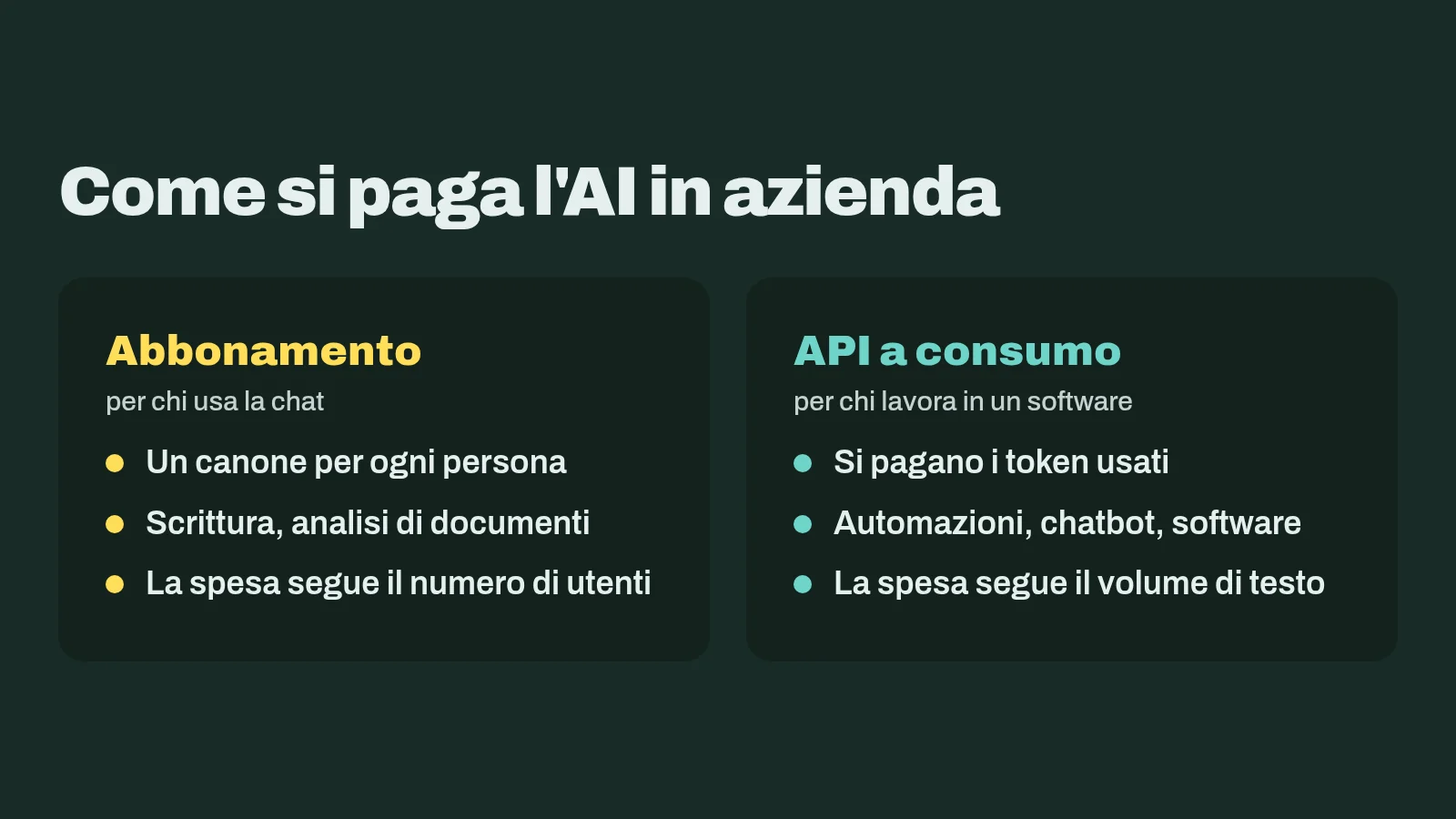
AI in a business is paid for in two ways: a subscription for each person who uses it, or pay-as-you-go (per token) when it works inside software or an automation. Subscriptions can be planned; usage depends on how much text goes through. You won’t find any figures on this page: price lists change often, so I only give links to the official pages, with the date I read them.
I’m Toure Tia Kevin, a developer in Bassano del Grappa, Italy. Here I don’t give quotes and I don’t repeat suppliers’ prices: I explain how the spend is calculated, where to read the current price list and what makes it rise. The calculation examples are made up and have no amounts.
Subscription or API: what changes
| Per-user subscription | Pay-as-you-go API | |
|---|---|---|
| How you pay | a fee per person | by tokens used, input and output counted separately |
| What it’s for | chat, writing, document analysis | automations, chatbots, software |
| Predictable spend | yes, by number of people | depends on the volume of text |
| Examples | ChatGPT Business, Claude Team, Gemini in Google Workspace | the APIs from OpenAI, Anthropic, Google, Mistral |
If you use AI from the chat window, you pay the subscription and never see changes to the APIs. If you have an AI chatbot on your website or an automation, you pay as you go, and what counts is how much text goes through and which model you pick. Team plans exist at all the main providers (for example the Team plan from Claude, with central billing and single sign-on); the terms differ from plan to plan and should be read on the provider’s page: ChatGPT plans and Google Workspace plans, where Gemini is included with features that vary by plan.
How pay-as-you-go works
API providers bill per million tokens and count separately the text you send (input) and the text the model writes (output). You can read this on the pricing pages of OpenAI, Anthropic, Google and Mistral.
A token is a piece of text, not a whole word: there is no fixed ratio and it depends on the model. Anthropic warns that the same text can give a different number of tokens on different models, and advises recounting your prompts on the model you will use. So the count is done with the provider’s tool, not by eye (Anthropic’s token counting is free and is an estimate).
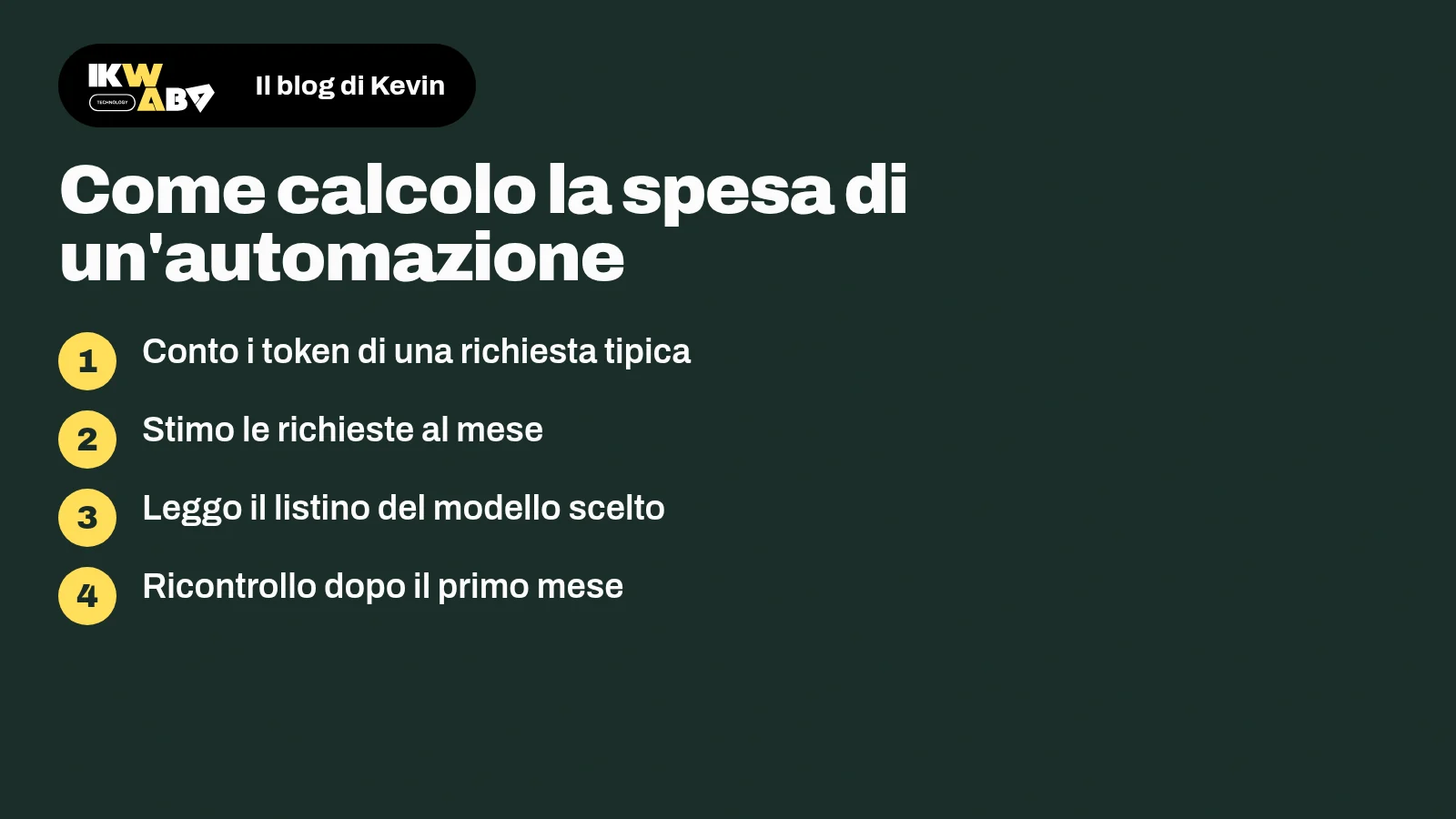
The calculation has four steps, the same for every provider:
- How much text per request: instructions, context and question (input), plus the expected answer (output). You count it with the provider’s tool on a real case.
- How many requests a month: from the history of the emails, calls or orders the automation will handle.
- The price list for the chosen model: input and output prices, read on the official page on the day you do the calculation.
- The product: input tokens × number of requests × input price, plus output tokens × number of requests × output price. Reread the result after the first month with real usage.
A made-up example, with no amounts: an assistant that answers customer emails reads the instructions, the history and the message every time, and writes a short reply. If the instructions are much longer than the reply, almost all the spend comes from the input: that’s where to work first.
Where to read the price list
Before any calculation, open the provider’s page: the price lists are almost all in dollars (Mistral also shows euros) and change with new models. The pages I check, read on 8 November 2026:
- OpenAI, API pricing: prices per million tokens, cached input, batch mode, thresholds for long context.
- Anthropic, Claude pricing: input, output, cache writes and reads; the Team plans are on the Claude plans page.
- Google, Gemini API pricing: free and paid tiers, context caching, batch.
- Mistral, pricing: token-based API and Team plan.
One difference that matters more than price: Google states that, on the free tier of the Gemini API, content may be used to improve its products, while on the standard paid tier it is not. For customer data, start from the paid tier and from written terms; see also the risks of AI used in secret inside a company (article in Italian).
How to spend less without losing quality
- The right model for each task: to sort emails, summarise or answer frequent questions, the small models from each provider are usually enough. The largest model is for complex reasoning. The gap between the two shows in the price list.
- Repeated text in the cache: instructions and documents that come back with every request can be cached, and the provider bills them at a reduced rate (“cached input” at OpenAI, prompt caching at Anthropic). At Google the cache also has a storage cost, which is in the price list.
- Batch processing: reports and analyses that aren’t needed right away can be sent in batch mode, at a reduced rate (“batch processing” at Anthropic; a similar mode at OpenAI, Google and Mistral).
- Shorter instructions: every line of instructions is paid for on every request. Cut what the model does well on its own.
- Measure: an automation that logs how many tokens each operation uses is quickly optimised.
The discounts for cache and batch are set by each provider, and they change them: the exact amount is on the pages above, not in this article. For the usage limits of subscriptions, which are a different kind of cap, see ChatGPT and Codex: a single usage quota from December (article in Italian).
What a project’s spend depends on
Subscriptions and APIs are only part of it. In a project with AI the spend depends on:
- how many people use AI and for which tasks (chat or tools inside the software);
- how many requests go through each month and how long they are;
- which model that task really needs;
- the work of whoever builds and maintains the system: integrations with your software, testing, fixes;
- data protection: the paid tier, the contract with the provider, the notice to customers.
For the building work I have a page on my services for AI and automation for businesses. The cost of a single chatbot is covered on its own page, AI chatbot for websites. If you want to understand how AI fits into a business’s processes, start from the guide to ChatGPT and AI for businesses.
What about European models?
If your data has to stay in Europe, Mistral AI’s models are one route to consider; for them too the price is on the official page, and where the data is processed should be checked in the provider’s documentation before you choose. I cover it in the guide on Mistral AI for business.
Frequently asked questions
How is AI paid for in a business?
With a subscription per person, if you use the chat, or pay-as-you-go with the APIs, if AI works inside software or an automation. Often the two exist side by side.
If I use ChatGPT on a subscription, do I also pay for tokens?
Normally not: the subscription and the API are separate products. Per-token prices apply to people using the APIs in software and automations. Subscriptions have their own usage limits, which depend on the plan.
Is the newest model always the best value?
No. The largest model costs more per token than the small ones, and for many repetitive tasks it isn’t needed. Try the small model on real cases first, and move to the large one only if the quality isn’t enough.
How can I forecast the spend of an automation?
Count the tokens of a typical request with the provider’s tool, multiply by the requests you expect in a month and apply the price list for the model. Then check real usage after the first month and correct the estimate.
Can I set a spending cap?
It depends on the provider: check in the API console whether spending limits or alerts exist, and set the ones available on day one. I don’t assume every provider offers them.
Why are there no prices on this page?
Because they change often, and a wrong or outdated figure is worse than no figure. I prefer to point to the official price list, which is always the right one.
If you’d like to talk it through, get in touch, and we’ll look together at where AI really helps in your business.
Sources
Read on 8 November 2026.
- OpenAI, API pricing (official price list)
- Anthropic, Claude pricing documentation
- Anthropic, Claude plans and pricing (Team and Enterprise)
- Anthropic, token counting
- Anthropic, prompt caching
- Anthropic, batch processing
- Google, Gemini API pricing
- Mistral AI, pricing
- OpenAI, ChatGPT plans
- Google, Google Workspace plans
Text prepared with AI and checked against the sources listed.